
Parkinson’s disease was once considered a condition that appeared quietly in a person’s late 60s or 70s. In India, that picture has changed significantly. A nationwide multi-centre study published in Movement Disorders (2025), covering 7,918 patients, found that the average age of Parkinson’s onset in India is 54.2 years, nearly a decade earlier than in most Western countries. More strikingly, 40 to 45% of Indian Parkinson’s patients develop their first symptoms between the ages of 22 and 49, one of the highest rates of early-onset Parkinson’s in the world.
Catching the early warning signs of Parkinson’s disease matters because earlier diagnosis means earlier treatment, better symptom management, and a significantly improved quality of life over the long term. Understanding the early signs of Parkinson’s disease – including both motor and non-motor Parkinson’s symptoms – is the most valuable step towards timely intervention.
What Is Parkinson’s Disease and Why Does It Happen?
Parkinson’s disease is a progressive condition affecting the nervous system, specifically the part of the brain that produces dopamine, a chemical that helps coordinate smooth, controlled movement. As dopamine-producing cells gradually reduce in number, movement, balance, and several other body functions are affected. Understanding Parkinson’s disease causes helps explain why early detection matters so much.
Key facts about Parkinson’s disease in India:
| Metric | Data | Source |
|---|---|---|
| Estimated Indians living with Parkinson’s | Approximately 12 lakh (1.2 million) | Healthcare Radius, NIMHANS estimates |
| Global prevalence increase (past 25 years) | Doubled | WHO Fact Sheet, 2023 |
| Parkinson’s disease in India: early onset (age 22 to 49) | 40 to 45% | Movement Disorders Society of India, 2023 |
| Mean age of PD onset in India | 54.2 years | Movement Disorders multicenter study, 2025 |
| Male to female ratio | Approximately 2.7 to 1 | North India epidemiological study |
| Genetic variants found in early-onset Indian patients | 15 to 20% | Annals of Indian Academy of Neurology, July 2025 |
| India’s projected global rank for PD burden (within 5 years) | Second highest in the world | PRAI International Symposium, 2026 |
What makes India’s Parkinson’s disease in India situation particularly significant is that many early-onset Parkinson’s cases in younger adults are initially attributed to work stress, burnout, or musculoskeletal problems, delaying Parkinson’s disease diagnosis by months or years.
Early Warning Signs of Parkinson’s Disease: The Full Picture
Parkinson’s symptoms fall into two categories:
Non-motor early signs, which often appear first:
- Loss of smell: A reduced or absent sense of smell, with no nasal infection or allergy, is one of the earliest documented pre-motor signs of Parkinson’s. It can precede motor symptoms by years
- Sleep disturbances: Acting out dreams physically during sleep, shouting, or moving vigorously while asleep, known as REM sleep behaviour disorder, is strongly associated with Parkinson’s and may appear long before movement symptoms
- Constipation: Persistent constipation without a dietary cause is a recognised early non-motor feature, as Parkinson’s affects the nervous system of the gut as well as the brain
- Mood changes: Depression, anxiety, or a flattening of emotional expression can be early features of Parkinson’s, unrelated to life events
- Low blood pressure on standing: Dizziness or lightheadedness when standing up quickly is a non-motor feature linked to the autonomic nervous system changes in Parkinson’s
Motor symptoms that appear as the condition progresses:
- Tremor at rest: A rhythmic shaking, typically starting in one hand or finger, that is most noticeable when the hand is relaxed and reduces with intentional movement. This is the most recognisable early sign
- Slowed movement (bradykinesia): Tasks that were once automatic take noticeably longer. Smaller steps when walking, reduced arm swing on one side, and difficulty getting up from a chair are common early presentations
- Muscle stiffness: Rigidity in the arms, legs, or neck, often described as a feeling of resistance when moving a limb
- Changes in handwriting: Letters become progressively smaller and more cramped over a line of writing, a pattern called micrographia
- Reduced facial expression: A decrease in the range of facial expressions, sometimes described as a masked or expressionless appearance, even when the person feels emotionally engaged
- Softer or more monotone voice: Speech may become quieter, faster, or less varied in tone without the person noticing the change themselves
Balance and posture changes: A slight forward lean or difficulty with balance when turning, which may present as near-falls or an unusual walking pattern
Parkinson’s Disease Treatment: What Is Currently Available
Parkinson’s disease management in India, as noted in a 2026 Journal of Movement Disorders national survey, is primarily initiated and managed by neurologists, with levodopa/carbidopa as the most widely prescribed medicine for levodopa Parkinson’s treatment.
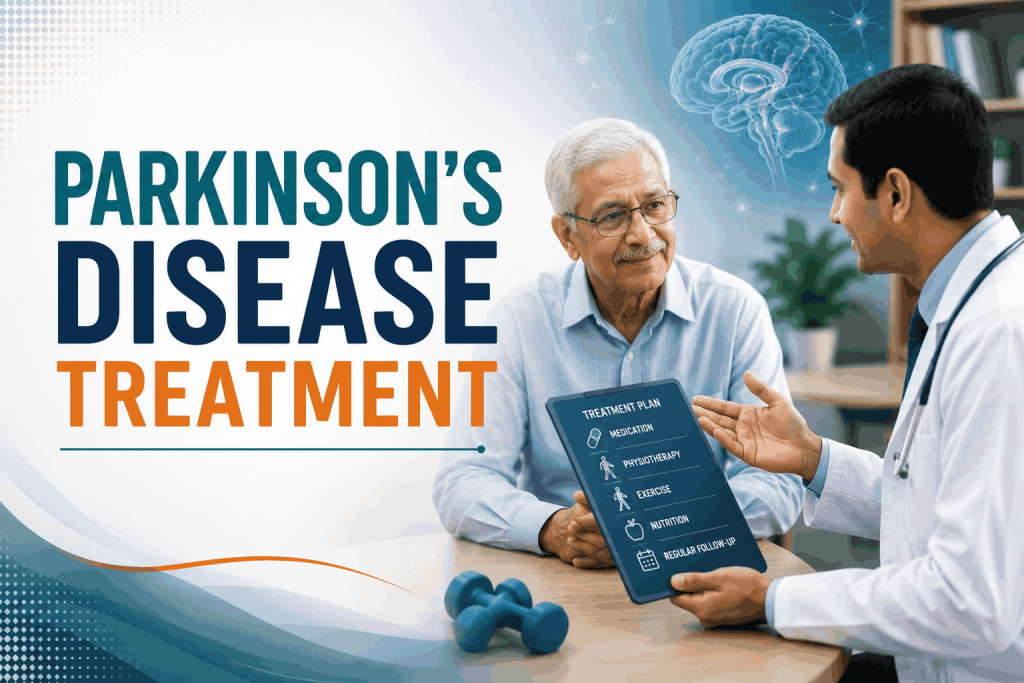
Current treatment options:
| Treatment | What it does | Stage typically used |
|---|---|---|
| Levodopa/carbidopa | Replaces dopamine in the brain, the most effective available medicine | All stages, primary treatment |
| Dopamine agonists | Stimulate dopamine receptors as an alternative or add-on | Early to mid-stage |
| MAO-B inhibitors | Slow the breakdown of dopamine in the brain | Early stage, as an add-on |
| Physiotherapy | Maintains mobility, balance, and posture | All stages, ongoing |
| Occupational therapy | Adapts daily tasks to maintain independence | Mid to later stages |
| Speech therapy | Addresses changes in voice and swallowing | As needed |
| Deep Brain Stimulation (DBS) | A small electrode implanted in the brain to regulate movement signals | Advanced cases where medicines alone are insufficient |
Newer treatment patches and extended-release formulations are under active development in India. Parkinson’s physiotherapy and speech therapy are a core part of Parkinson’s disease management at all stages, alongside medication. For advanced cases, deep brain stimulation research shows sustained benefits in reducing motor fluctuations.
When to See a Neurologist
See a neurologist in Hyderabad promptly if you or a family member notices any of the following signs of Parkinson’s disease, particularly if symptoms appear in someone under 60:
- A persistent resting tremor Parkinson’s pattern – rhythmic shaking in one hand or finger
- Noticeable slowing of movement in daily activities, including writing, buttoning clothes, or getting up from a seated position
- Unexplained loss of smell lasting several months with no nasal cause – a key early warning sign of Parkinson’s
- Acting out dreams physically during sleep
- A significant change in handwriting (micrographia Parkinson’s), posture, or facial expression
- Balance difficulties or unexplained near-falls
There is no single blood test or scan that definitively confirms Parkinson’s disease diagnosis. Diagnosis is based on a neurologist’s clinical assessment of symptoms, their pattern, and progression. The earlier this Parkinson’s disease diagnosis takes place, the more treatment options are available.
Parkinson’s disease is a condition that can be managed effectively, particularly when identified before symptoms become pronounced. In India, where young onset Parkinson’s cases are disproportionately high and awareness remains limited, early recognition of the first signs of Parkinson’s disease is the most impactful step families and individuals can take.
Speak with the best neurologists in Hyderabad at Omega Neuro Sciences Hospitals. The neurology team offers comprehensive Parkinson’s assessments, personalised treatment planning, and access to both medical and therapeutic management options, giving patients the best foundation for long-term quality of life.